

Types of hot springs
Geothermal rivers, natural pools, hot pots, spouting springs and mud pools — what each one is, how it forms, and which are safe to enter.
- 7 min
- Reading time
- Field-based
- Source
- General
- Location detail
- Reviewed
- Safety content
The Types of Hot Springs in Iceland, and Which Ones You Can Bathe In
People use “hot spring” for everything from a scalding mud pool to a concrete village pool fed by a borehole. They are not the same thing, and confusing them is how visitors get hurt. Here is the working vocabulary we use in the field.
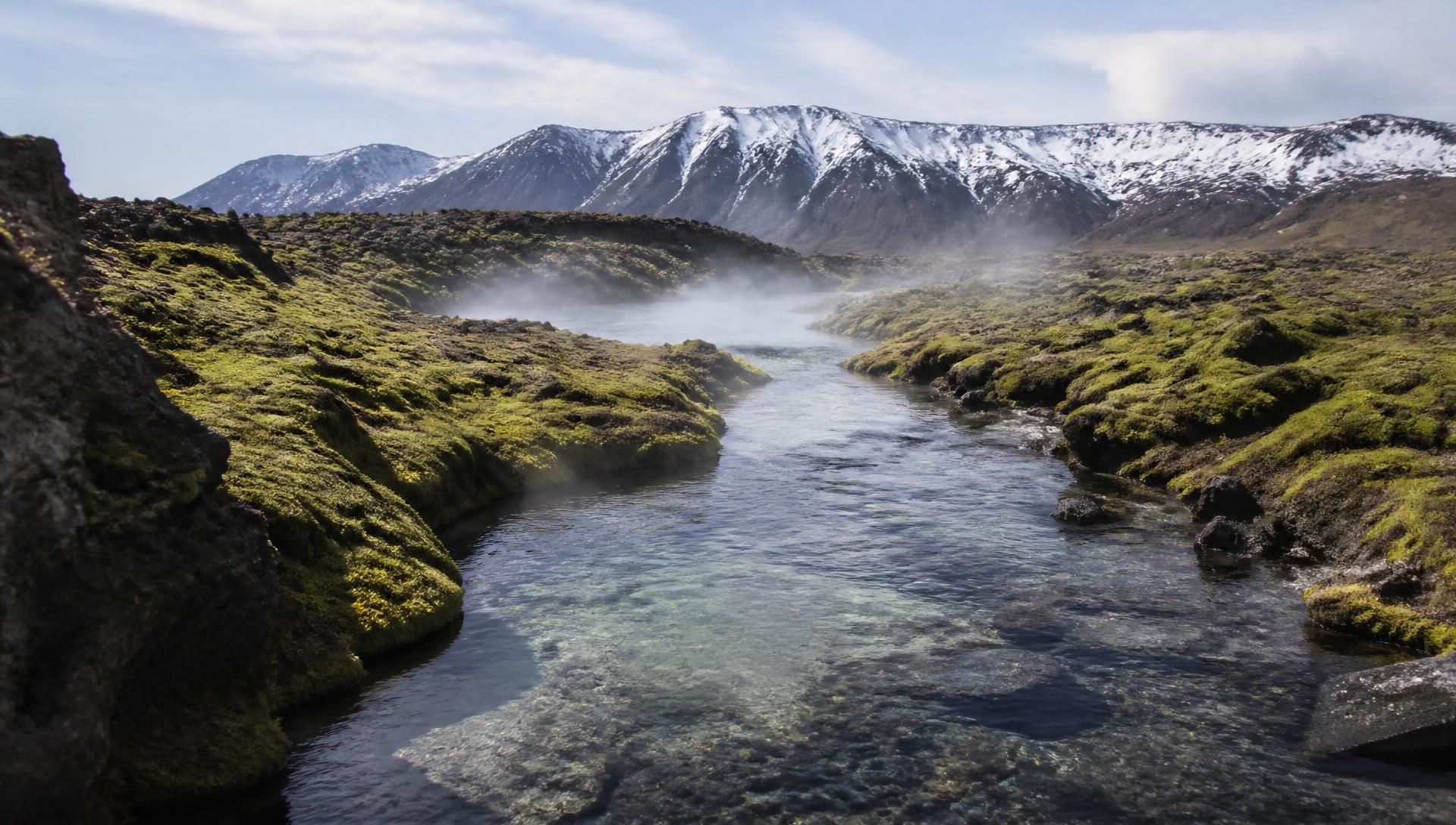
Geothermal rivers
A cold surface river meets hot groundwater and the two mix along a stretch of the channel. Temperature varies with distance downstream, with rainfall and with the season, so the comfortable stretch moves. These are among the most bathable features in Iceland because the mixing is self-regulating: walk upstream to get hotter, downstream to cool off.
They are also the features most damaged by traffic. Bank erosion from thousands of footsteps is visible at the well-known ones, which is one reason many landowners are cautious about new attention.
Natural pools and hot pots
A natural pool is a basin where geothermal water collects with little or no construction. A hot pot (heitur pottur) usually implies some human work — a stone rim, a pipe, a drain plug. Many of the pools travellers picture as wild are in fact century-old farm hot pots that someone still maintains.
Maintenance matters for your safety and for access. A pool with an owner has a drain, a cleaning cycle and often a rule about numbers. A truly unmanaged pool has none of those, and its water can sit warm and stagnant for weeks.
Features you never enter
Some geothermal features look inviting in photographs and will injure you badly.
- Spouting springs and geysers — the water is at or near boiling and eruptions are irregular.
- Fumaroles and steam vents — superheated steam causes deep burns at a distance.
- Mud pools — boiling, acidic, and the surrounding crust is often unstable.
- Any pool inside an active high-temperature field without a marked path.
Village pools and geothermal lagoons
Almost every Icelandic settlement has a municipal swimming pool heated geothermally, and they are the backbone of local social life. Commercial lagoons are a separate category again: constructed, ticketed and often fed by an industrial borehole rather than a surface spring.
Neither is a wild hot spring, but both belong in a survey of geothermal bathing because they are how most people in Iceland actually bathe.
Common questions
- Are Iceland's wild hot springs free to use?
- Many are, but almost all sit on private land. Free to enter is not the same as open to the public: access depends on the landowner, and it can be withdrawn after damage or overcrowding.
- How can I tell whether water is safe before getting in?
- Test with a hand rather than a foot, look for a mixing source such as an inflowing stream, and avoid any water with a strong sulphur haze, boiling movement or a crusted rim. If nothing tells you where the heat comes from, do not enter.
Continue the primer
Safety
The four things that actually injure people at Icelandic geothermal sites, and the field checks that prevent it.
Etiquette & access
Showering rules, private land, parking, numbers and why several well-known springs have closed to visitors.
Seasons & access
How the season decides which springs are reachable, what the highland road opening means, and what changes in winter.
Get the field dispatch
Short updates from the road while the survey is running: springs measured, access won or lost, weather, corrections and what the next leg costs. No selling, and you can leave at any time.
This survey runs on funded mileage.
Sponsors cover getting to sites, permissions and verified documentation. Editorial judgement and safety findings are never for sale.